
Professional tartar removal in Budapest, District XII
When you run your tongue over your teeth, do they feel rough? Do you see yellowish deposits between your teeth, or do your gums bleed when you brush?
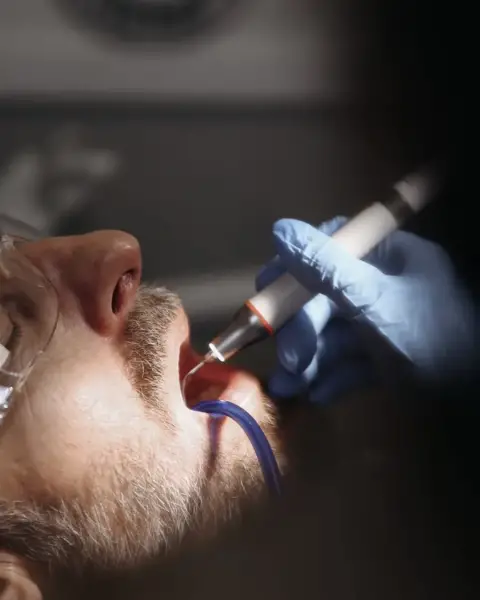
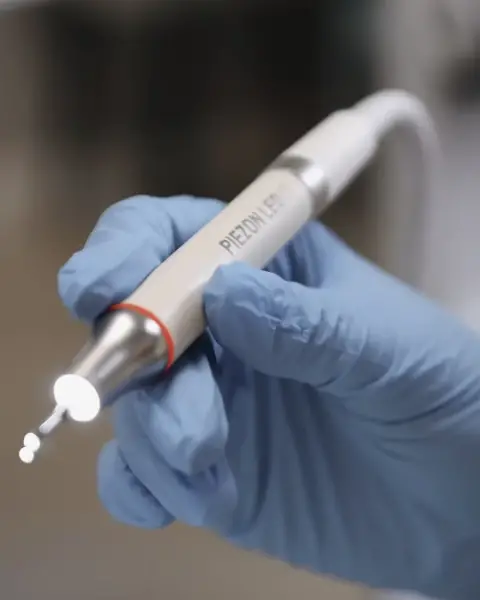
This probably means you have tartar, which you can no longer remove at home. At my practice, tartar removal is part of Guided Biofilm Therapy (GBT), which means I remove the hard deposits painlessly with a PIEZON® ultrasonic device.
What is worth knowing about the treatment:
- After a treatment of about one hour, you go home with smooth, clean teeth;
- The basic price of the treatment starts from 47,000 HUF (GBT basic treatment);
- A painless therapy without anaesthesia;
- The practice is in District XII, at Maros utca 30/b.
How does tartar form?
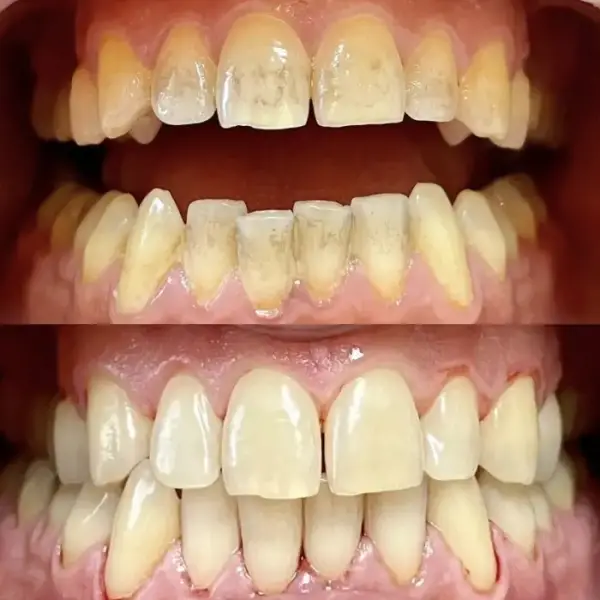
During the day, a thin, colourless layer of plaque that is barely visible to the naked eye forms on the surface of your teeth. It is not only an excellent breeding ground for bacteria, but over time it hardens and calcifies due to the minerals in your saliva. This is what we call tartar.
It is important to know that tartar that has already formed can no longer be removed by brushing at home. The longer it stays in your mouth, the more of it builds up and the darker it becomes. Home remedies such as baking soda, lemon juice or scraping tools from the shops cannot solve this problem either, and they can even be dangerous, as they can damage the enamel or the gums. I wrote about this in detail in my blog post Removing tartar at home (in Hungarian).
What happens if the tartar stays?
Tartar is not only an aesthetic problem, it is also one of the main causes of gum disease. Bacteria settle easily on its rough surface and keep the gums constantly inflamed. The gums lose their healthy colour, turn red, swell, and start to bleed when you brush or eat, and later even on their own. Tartar also often causes bad breath.
If tartar is not removed in time, the gums recede, the inflammation spreads along the tooth roots to the jawbone, the teeth become sensitive to cold and heat, and in severe cases they can even loosen, which can lead to tooth loss. I write more about this on the gingivitis treatment page and in the post Gingivitis or periodontal disease? (in Hungarian).
How I remove tartar
At my practice, tartar removal is not “scraping” but part of a complete treatment. This is Guided Biofilm Therapy, and its steps build on each other:
1. Assessment. I check your teeth, your gums and your dental work, and we discuss what you need.
2. Disclosing the plaque. I stain the plaque that cannot be seen with the naked eye, so I can see exactly where cleaning is needed.
3. AIRFLOW®. With a mixture of water, air and very fine powder I remove plaque, stains and young tartar, also from between the teeth and along the gum line. If needed, I also clean the pockets under the gums with PERIOFLOW®.
4. PIEZON®. I remove the remaining hard tartar with an ultrasonic device. Its special feature is that tiny vibrations detach the tartar from the tooth surface while a water jet cools the teeth. The ultrasound at this special frequency only harms the tartar, it does not damage the enamel.
5. Check. I check that every area is clean, and you can also see the result in a hand mirror.
6. Gum care and advice. I finish the treatment with hyaluronic acid and vitamin E gum nourishment, and then I show you which tools to use and how to clean your teeth at home.
You can read about the steps and the technology in detail on the Guided Biofilm Therapy page.
How is GBT different from classic scaling?
Classic scaling consists of ultrasonic cleaning and polishing with paste and a rubber cup. I have been doing this differently for years:
| Aspect | Classic scaling | At my practice, with GBT |
|---|---|---|
| What does it clean? | What can be seen with the naked eye | Also the disclosed plaque, on every tooth |
| Treating plaque and stains | With polishing paste and a rubber cup | With the AIRFLOW® PLUS device, without scratching |
| Removing hard tartar | With an ultrasonic device | With the PIEZON® ultrasonic device, with NO PAIN technology |
| Gum line, tongue | Not reached | I clean these too |
What does it clean?
Classic scaling: What can be seen with the naked eye
At my practice, with GBT: Also the disclosed plaque, on every tooth
Treating plaque and stains
Classic scaling: With polishing paste and a rubber cup
At my practice, with GBT: With the AIRFLOW® PLUS device, without scratching
Removing hard tartar
Classic scaling: With an ultrasonic device
At my practice, with GBT: With the PIEZON® ultrasonic device, with NO PAIN technology
Gum line, tongue
Classic scaling: Not reached
At my practice, with GBT: I clean these too
For the patient, this means that no plaque is left even where it cannot be seen with the naked eye, and there is no need to worry about abrasive polishing paste. The method does not scratch implants, crowns, veneers or braces either, so it can be used safely in these cases too.
Does tartar removal hurt?
Not with me. Many people have asked me this, especially those who had a bad experience with scaling before. The PIEZON® device works with so-called NO PAIN technology: its tip only works when it meets tartar, so it does not touch the healthy tooth surface unnecessarily. No anaesthesia is needed.
What is good to know, however: if your gums are very inflamed, your tooth necks are sensitive, or there is a lot of tartar under the gums, you may feel temporary sensitivity. In that case, tell me, and I will adapt to you. If your teeth are generally sensitive in everyday life too, reducing tooth sensitivity can also help you.
“Painless teeth cleaning and scaling do exist. I did not believe it either. In the past I taught quite a lot of classes to dental students at the university on medical communication and psychology. I know how much people fear these treatments. That is why I recommend Heni!”
Éva Knapek, clinical psychologist
Removing tartar under the gums
Tartar can form not only on the visible tooth surface but also under the gums. In this case a pocket forms between the gum and the tooth, which a toothbrush can no longer clean. This is what the GBT PERIOFLOW® treatment is for: with its special, thin nozzle I can remove biofilm and deposits from gum pockets as deep as 4-9 mm, as well as around implants. I can tell you at the consultation whether you need it.
How much does tartar removal cost?
At my practice, every type of tartar removal is done with Guided Biofilm Therapy. Which one is right for you depends on the condition of your teeth and gums.
| Treatment | Who is it for, how long does it take? | Price |
|---|---|---|
| Guided Biofilm Therapy (GBT), basic treatment | Tartar removal on the lower and upper dental arches and between the teeth, with gum nourishment and advice. About 50-60 minutes. | 47,000 HUF |
| GBT FOR SMOKERS treatment | For smokers: to remove more stubborn stains and nicotine marks. About 60-70 minutes. | 52,000 HUF |
| GBT PERIOFLOW® treatment | Cleaning under the gums, in gum pockets and around implants, as deep as 4-9 mm. About 60-70 minutes. | 57,000 HUF |
| GBT FOR KIDS treatment | For children aged 2 to 12, with playful plaque disclosing. About 40-50 minutes. | 37,000 HUF |
Guided Biofilm Therapy (GBT), basic treatment
Tartar removal on the lower and upper dental arches and between the teeth, with gum nourishment and advice. About 50-60 minutes.
47,000 HUF
GBT FOR SMOKERS treatment
For smokers: to remove more stubborn stains and nicotine marks. About 60-70 minutes.
52,000 HUF
GBT PERIOFLOW® treatment
Cleaning under the gums, in gum pockets and around implants, as deep as 4-9 mm. About 60-70 minutes.
57,000 HUF
GBT FOR KIDS treatment
For children aged 2 to 12, with playful plaque disclosing. About 40-50 minutes.
37,000 HUF
The price list is valid from 5 January 2026; you can find the full list on the Prices page.
Not sure which type you need? Call now or request a callback, and we will talk it over.
How often should tartar be removed?
Tartar forms again and again, so regular treatment is the basis of prevention. I usually recommend it at least twice a year, but lifestyle and individual circumstances can change this. At the end of the treatment we always discuss when you should come back, and if you like, I let you know when it is due.
Regular treatment prevents gingivitis and periodontal disease, which matters all the more because, without proper therapy, the latter can even lead to tooth loss.
Every six months: if your gums are healthy.
More often: if you smoke.
Every 3 months: with more advanced gingivitis or periodontal disease.
After tartar removal
After the treatment your teeth will be smooth and clean, and plaque will stick to them less easily. To keep it that way as long as possible, at the end of the treatment I show you how and with which tools to clean your teeth and the spaces between them at home. If you would like more detailed, personalised help, book an individual oral care consultation.
If you are planning teeth whitening, tartar removal is also unavoidable, because freshly cleaned tooth surfaces are a precondition of whitening. You can read about this on the professional teeth whitening page.
If you would like to know more about tartar
Tartar: everything you need to know
What makes it form faster, and how to prevent it: read it here (in Hungarian).
Removing tartar at home
Why not to try it at home: Removing tartar at home, should you or shouldn't you? (in Hungarian)
About Guided Biofilm Therapy
How GBT works: Ultramodern technology for healthy teeth (in Hungarian).
Where to find me
I welcome you in Budapest District XII, at Maros utca 30/b (1st floor), roughly halfway between Déli pályaudvar and Széll Kálmán tér.
Phone: +36 30 758 8344
E-mail: info@dentalsalon.hu
You can also ask for an appointment on the callback request page, and I will call you back.
Frequently asked questions about tartar removal
Does tartar removal hurt?
Not with me. The tip of the PIEZON® ultrasonic device only works when it meets tartar, so it does not touch the healthy tooth surface unnecessarily. No anaesthesia is needed. With inflamed gums or sensitive tooth necks, temporary discomfort may occur; in that case, tell me, and I will adapt to you.
How much does tartar removal cost?
At my practice, tartar removal is done with Guided Biofilm Therapy, which starts from 47,000 HUF. The version for smokers costs 52,000 HUF, the PERIOFLOW® treatment 57,000 HUF and the one for children 37,000 HUF. The price list is valid from 5 January 2026.
How long does the treatment take?
The basic treatment takes about 50-60 minutes, the FOR SMOKERS and PERIOFLOW® versions about 60-70 minutes, and the one for children about 40-50 minutes.
How often should tartar be removed?
I usually recommend it at least twice a year. More often if you smoke, and every 3 months with more advanced gingivitis or periodontal disease.
Can tartar be removed at home?
No. Hardened tartar can no longer be removed by brushing, and home remedies and scraping tools can damage both the enamel and the gums. The most you can do at home is prevention.
Can you also remove tartar under the gums?
Yes, that is what the GBT PERIOFLOW® treatment is for: with it I can clean gum pockets as deep as 4-9 mm and the areas around implants.
Can tartar be removed in children too?
Yes, I recommend the GBT FOR KIDS treatment between the ages of 2 and 12. We start with playful plaque disclosing, and at the end I introduce the child to using dental floss.
Book an appointment!
If you can feel tartar with your tongue or your gums are bleeding, do not wait until it starts to hurt. Request a callback, and we will agree on a suitable time. At the first appointment I check your teeth, and we discuss which treatment you would need. I look forward to seeing you!