
Tooth polishing: smooth, shiny and healthy teeth, painlessly
Do you feel that your teeth are still not clean enough after brushing?
Get rid of stubborn stains and plaque painlessly, in just 30 minutes.
- Treatment of about 30 minutes
- Painless, even for sensitive teeth
- Practice in District XII, at Maros utca 30/b
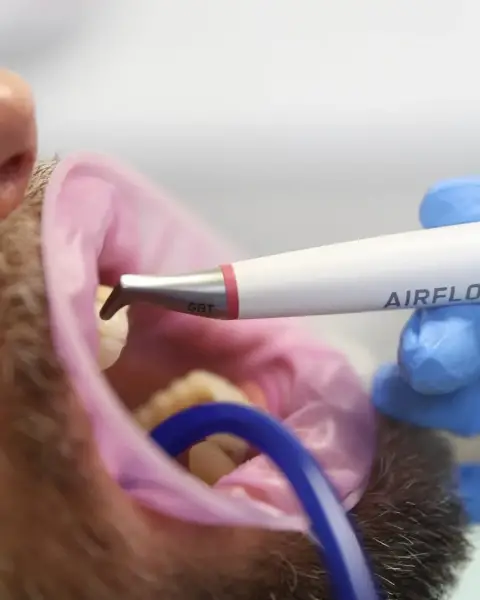
Looking in the mirror in the morning, do your teeth seem yellower, even though you scrub them with the most expensive toothpaste?
When you run your tongue over your teeth, does the surface feel annoyingly rough, even after the most thorough brushing?
Do you love coffee, tea or red wine, but hate the marks they leave on your smile?
Are you afraid of traditional tartar removal because you had an unpleasant or painful experience before?
If you nodded to at least one of these, let me reassure you: it is not your fault. Regular brushing and home remedies simply cannot clean your teeth perfectly. But there is a solution, one that does not scrub, does not scratch and does not hurt, yet it works... It is tooth polishing.
What exactly is tooth polishing?
Tooth polishing is a professional oral hygiene procedure that makes your teeth smoother, whiter and shinier. But this treatment is not only about looks: it also helps keep your teeth and gums healthy, because when done regularly, it can prevent gingivitis and other oral hygiene problems.
If you want to know more, I wrote a separate article on what exactly it means and what this treatment is good for (in Hungarian).
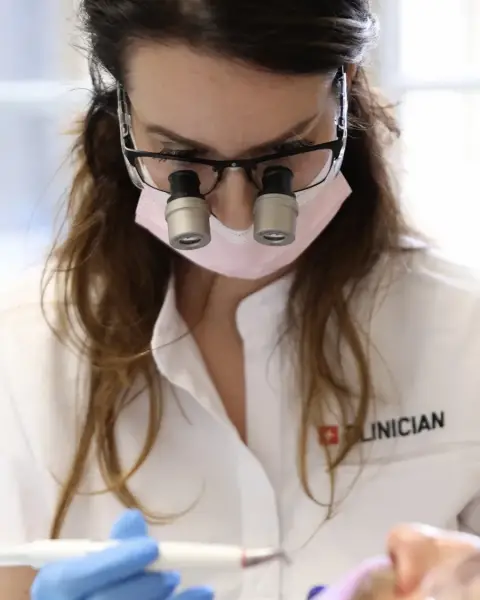
The benefits of tooth polishing
Tooth polishing has several benefits. First, a smooth tooth surface makes it harder for plaque and bacteria to stick, so the risk of tooth decay, tartar build-up and gingivitis goes down. Second, it can remove surface stains, so your teeth can look whiter after the treatment. On top of all this, your breath and your mouth feel fresher.
The treatment is especially recommended if you:
- regularly have staining drinks or food (e.g. coffee, tea, red wine), because these often leave marks on the tooth surface, which polishing removes effectively;
- wear braces, because the areas around the appliance are harder to clean, and polishing helps prevent plaque build-up and staining;
- are about to have braces fitted, because a smooth, clean tooth surface gives the best starting point for orthodontic treatment;
- smoke, because nicotine and tar can cause yellowish stains on the tooth surface, which polishing can visibly reduce;
- are planning tooth whitening or have already had it, because polishing helps the whitening agents spread more evenly and keeps the whitening result longer;
- want to make your oral hygiene treatments more effective, because a smooth, clean tooth surface is less favourable for new deposits.
So regular tooth polishing not only improves how your teeth look, it also helps keep your whole mouth healthy.
Tooth polishing at DentalSalon: AIRFLOW® tooth polishing (Airflowing)
Tooth polishing can be done in several ways, depending on the result we want and the condition of the patient's teeth.
At DentalSalon, instead of classic polishing, I use AIRFLOW® tooth polishing (Airflowing):
AIRFLOW® tooth polishing (Airflowing)
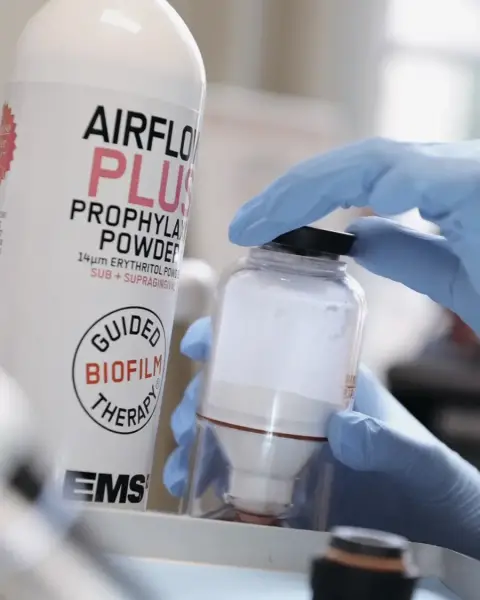
This modern technology cleans the tooth surface with a mix of water, air and fine powder. The erythritol-based molecule used in the procedure allows unique use both supragingivally and subgingivally (above and below the gum line). With its 14-micron granule size, AIRFLOW® PLUS powder has the finest particles in dentistry, and its great advantage is that it is minimally abrasive: it removes biofilm effectively without harming soft or hard tissue.
On top of that, thanks to its sweet taste and gentleness, it works well for children too, not only for people who wear braces, returning patients, or those who come to the practice for primary or secondary prevention. The treatment is especially effective in hard-to-reach places, for example around braces or between the teeth, and since it is completely painless, it does not cause discomfort even for patients with sensitive teeth.
This complex effect is achieved by using the AIRFLOW® MAX handpiece and AIRFLOW® PLUS powder together: neither can do it alone.
AIRFLOW® technology is also an important step of Guided Biofilm Therapy (GBT). Hard, mineralized tartar, however, I remove not with this, but with a PIEZON® ultrasonic device.
How is this different from classic tooth polishing?
I have not used classic tooth polishing, that is, polishing paste, rubber cups or coarse, bicarbonate-based powder (so-called “air polishing”), for years. Instead, I do Airflowing, which means I use the AIRFLOW® MAX handpiece together with the 14-micron, erythritol-based AIRFLOW® PLUS powder.
Airflowing does not change any surface: it does not damage the enamel of healthy teeth, milk teeth, dental restorations, braces or implants, or the areas around them. It does not scratch or thin the surface, so it can be repeated often.
During the treatment I also clean the surface of the tongue and the gum line around the teeth. Traditional tartar removal does not reach these soft areas.
So why do I still call it tooth polishing? Because that is the name most people search for, and because Airflowing is the modern form of tooth polishing today.
Tooth polishing step by step
Tooth polishing is a treatment with several stages, where each step builds on the previous one for the best result.
Step 1: Check-up
I start every tooth polishing by thoroughly examining my patient's teeth and mouth. This way I can rule out problems (for example inflammation or decay) that could get in the way of the treatment.
Step 2: Tooth polishing
Next comes the polishing itself: the AIRFLOW® device cleans the tooth surfaces, the spaces between the teeth and the gum line with a mix of water, air and very fine powder, adjusted to the current condition of the teeth and gums.
Step 3: Rinsing
At the end of the treatment I ask the patient to rinse their mouth thoroughly, removing any material and tiny particles left over from the polishing.
Step 4: Advice
I always finish the treatment with personalized advice: together with the patient, we talk through how best to continue oral care at home and what to pay attention to, so that the fresh, clean feeling lasts as long as possible.
How long does it take, and how much does it cost?
A stand-alone AIRFLOW® treatment takes about 30 minutes, depending on the condition of your teeth and the amount of deposits.
| Treatment | What does it include? | Price |
|---|---|---|
| AIRFLOW® tooth polishing (Airflowing) | With AIRFLOW® PLUS powder, I remove biofilm and stains from the tooth surfaces in a minimally invasive way. | 37,000 HUF |
AIRFLOW® tooth polishing (Airflowing)
With AIRFLOW® PLUS powder, I remove biofilm and stains from the tooth surfaces in a minimally invasive way.
37,000 HUF
The price list is valid from 5 January 2026; you can find the full list on the Prices page.
Would you like a brighter smile? Call now or request a callback, and we will find a time that suits you.
Polishing or whitening?
Many people ask me what the difference is between the two. In short: polishing removes deposits and stains from the surface of the teeth, while whitening lightens the natural colour of the teeth. The two complement each other well, but they are by no means a substitute for each other. I wrote about this in detail here: Polishing or whitening? When to choose which (in Hungarian). If you are planning whitening, you will find all the important information about the treatment on the professional tooth whitening page.
Where to find me
I welcome you in District XII of Budapest, at Maros utca 30/b (1st floor), roughly halfway between Déli pályaudvar (Southern Railway Station) and Széll Kálmán tér.
Phone: +36 30 758 8344
Email: info@dentalsalon.hu
You can also ask for an appointment on the callback request page, and I will call you back.
Frequently asked questions about tooth polishing (FAQ)
How often should I book a tooth polishing?
How often depends on many factors, for example your oral hygiene, whether you smoke or drink coffee, and genetics also play a part. Since this treatment is extremely gentle and not abrasive at all, it can be done as often as needed. Experience shows, however, that after about six months without treatment it is better to book a GBT cleaning, because tartar can form in that time.
How much does tooth polishing cost?
AIRFLOW® tooth polishing (Airflowing) costs 37,000 HUF. The price list is valid from 5 January 2026; you can find the prices of other treatments on the Prices page.
How long does tooth polishing take?
A stand-alone AIRFLOW® treatment takes about 30 minutes, depending on the condition of your teeth and the amount of deposits. This is not the length of the full Guided Biofilm Therapy (GBT).
Does tooth polishing hurt?
The procedure usually causes no pain at all, but with sensitive teeth you may sometimes feel a little discomfort. If this happens, it is important to tell me right away so that I can adjust the treatment.
When can I eat after tooth polishing?
After tooth polishing there is usually no restriction on your next meal, so patients can eat and drink right after the procedure. It is worth paying attention, though, to what you eat and drink, because certain foods can stain the teeth.
What should I not eat or drink after tooth polishing?
There are no forbidden foods or drinks, but it is best to avoid, for example, coffee, tea, red wine and certain fruit juices, as well as smoking, because these contain a lot of pigment and can leave stains on the teeth, especially shortly after polishing.
How is AIRFLOW® treatment different from traditional tooth polishing?
AIRFLOW® treatment is a state-of-the-art procedure that removes biofilm and stains from the tooth surface in a minimally invasive way, and it also works very well below and above the gum line. The fineness of the powder (14-micron granule size) and its minimal abrasiveness make it the gentlest solution in dentistry, so it can safely be used for everyone, including children.
Why do dental hygienists recommend tooth polishing?
Tooth polishing is recommended because it helps remove the plaque that sticks to the tooth surface, which in the long run can cause tooth decay and gum disease. Polishing also helps restore the natural whiteness of the teeth. So regular tooth polishing helps both keep your teeth healthy and improve how they look.
Book an appointment
If you would like your teeth to be smooth and shiny again, book an appointment with me. I look forward to seeing you!